
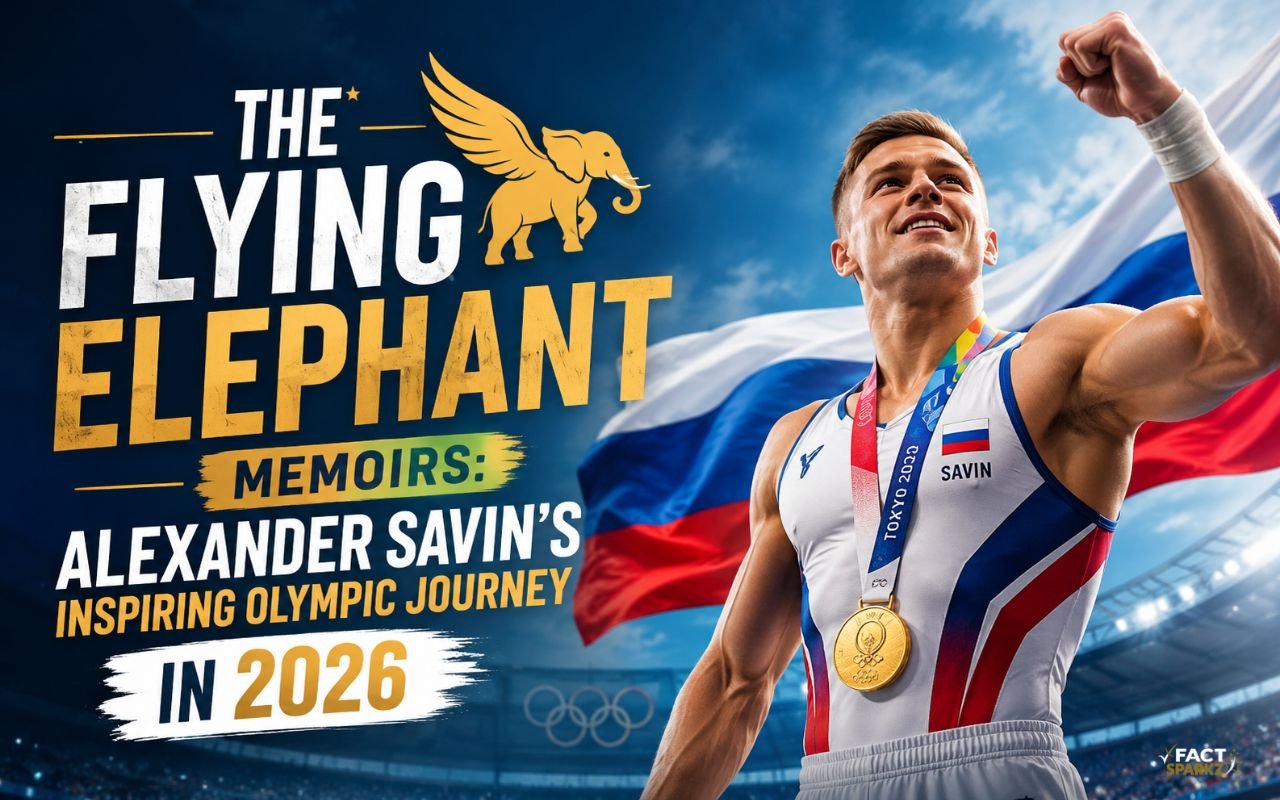
What really happens behind an Olympic champion’s biggest victories? The Flying Elephant Memoirs of an Olympic Champion offers a closer look at Alexander Savin’s remarkable journey through Soviet volleyball, elite competition, and Olympic glory. His story goes beyond medals, exploring the discipline, pressure, sacrifice, and resilience required to compete at the highest level.
For readers interested in Olympic volleyball, athlete psychology, and sports history, the memoir provides a fascinating perspective on an era when international competition carried enormous significance. It also helps explain why Savin became such a memorable figure in volleyball. Before deciding whether the book is worth reading, it helps to understand his career, the era behind it, and what makes this memoir distinctive.
The Flying Elephant Memoirs: What Is the Book About?
The Flying Elephant: Memoirs of an Olympic Champion is a sports memoir centered on Alexander Savin’s life and career in high-level volleyball. The book connects his development as an athlete with international competition, Olympic experiences, teammates, training, and the sporting environment of the Soviet era. Current descriptions of the English edition also highlight its substantial photographic collection.
The book is therefore more useful to readers who want context than to someone looking for nothing but match results. Savin’s career provides the framework, while the broader story reveals what elite competition required from an athlete during a very different period of professional sport.
The Book at a Glance
| Detail | Information |
| Title | The Flying Elephant: Memoirs of an Olympic Champion |
| Author | Alexander Savin |
| Sport | Volleyball |
| Olympic highlight | Gold, Moscow 1980 |
| Earlier Olympic result | Silver, Montreal 1976 |
| English format discussed | Kindle edition |
| Reported length | About 514 pages |
| Reported photographs | 240+ |
These edition details come from current online listings and coverage, so readers should verify the retailer page for the exact version available in their market.
Who Is Alexander Savin?
Alexander Savin was a Soviet volleyball player who became one of the prominent athletes of his generation. He played as a middle blocker and represented both CSKA Moscow and the Soviet national team during an exceptionally competitive period in international volleyball. Biographical sources place his birth in 1957 and identify his Olympic record as silver in Montreal in 1976 and gold in Moscow in 1980.
His significance extends beyond those two Olympic medals. Savin competed in an era when Soviet volleyball regularly challenged for major international titles. Records and contemporary summaries also associate him with World Championship, World Cup, and European Championship success. He was later inducted into the Volleyball Hall of Fame in 2010, further establishing his place in volleyball history.
That background matters when approaching the memoir. You aren’t reading about an athlete who briefly reached the Olympic stage. You’re reading about someone who spent years inside an elite volleyball system and experienced international competition at its highest level.
Alexander Savin’s Journey to Olympic Glory
Savin’s Olympic story has a particularly interesting shape because it wasn’t an uninterrupted march toward gold. At the 1976 Montreal Olympics, the Soviet Union reached the men’s volleyball final but lost to Poland, taking silver. Historical volleyball material from the period identifies Savin among the important players in the renewed Soviet team.
Four years later, the outcome changed. At the 1980 Moscow Olympics, the Soviet team won the gold medal on home soil. The tournament took place during the Cold War and was heavily affected by the boycott of the Games by many Western nations, including the United States. That political backdrop makes Savin’s Olympic achievement part of a much larger historical story.
From Silver to Gold
The contrast between Montreal and Moscow is one of the strongest reasons to examine Savin’s career through a memoir rather than a medal table.
Silver in 1976 established his Olympic credentials. Gold in 1980 completed the journey.
Between those events came years of training, international tournaments, tactical development, and continued competition. Savin also accumulated major international honors during this period, including World Cup, World Championship, and European Championship titles.
That progression offers a useful lesson about resilience after setbacks. Elite performance rarely develops from one dramatic breakthrough. It is usually built through repetitive training, competition, adjustment, and the willingness to keep improving after disappointment.
How Savin Became an Elite Volleyball Player
A medal can make athletic achievement look deceptively simple. The reality is much more complicated. Volleyball demands physical preparation, technical precision, tactical awareness, timing, and coordination with teammates.
Savin’s position as a middle blocker was particularly demanding. The role requires rapid reactions around the net, effective blocking, attacking ability, and constant reading of the opposing team’s setter and hitters. His career illustrates how an Olympic-level athlete needs much more than raw physical ability.
Physical and Technical Preparation
Elite volleyball depends on explosive movement and repeatable technique. A middle blocker must transition quickly, read developing plays, jump efficiently, and make decisions within fractions of a second.
Those skills come from intense training and repetitive practice, not occasional bursts of motivation. Years of structured preparation allow movements to become more automatic when competitive pressure rises.
Learning Through Competition
Competition also exposes weaknesses that training alone may not reveal. An opponent can challenge timing, positioning, confidence, or tactical assumptions in ways that force an athlete to adapt.
Savin’s Olympic journey illustrates this broader principle. The difference between finishing second and eventually winning gold wasn’t simply talent. It was the continued development that takes place between major competitions.
The Soviet Volleyball Era Behind the Memoir
Understanding Savin’s career requires some understanding of the Soviet sporting environment.
During the 1970s and 1980s, the Soviet Union maintained a highly organized sports system and competed intensely across international athletics. Volleyball became one of the sports in which the country regularly produced world-class teams and players.
For Savin, this wasn’t simply an individual pursuit. His career unfolded within team-based training, national competition, international tournaments, and a broader culture that placed considerable importance on sporting success.
Volleyball and the Cold War
The Moscow Olympics add another layer to that history. The 1980 Games occurred during heightened Cold War tensions, and the boycott led by the United States significantly changed the field of competition. Historical records note that 58 countries were absent from the Games.
That context doesn’t diminish the athletic preparation involved. It does, however, remind modern readers that Olympic sport has always existed within a wider social and political environment.
Savin’s memoir consequently has value beyond volleyball technique. It can also be read as a firsthand window into an era when athletes represented more than themselves.
What Made the “Flying Elephant” Nickname So Memorable?
The title immediately creates curiosity because “Flying Elephant” combines two ideas that seem contradictory.
An elephant suggests size, strength, and weight. Flying suggests lightness, elevation, and movement.
That contrast fits the image associated with Savin’s volleyball career. Contemporary descriptions characterize him as a powerful player whose physical presence was combined with impressive movement and jumping ability.
The nickname also works because sports history is often preserved through memorable identities. Statistics tell you what an athlete achieved. A nickname can help communicate how spectators remembered the athlete.
In that sense, The Flying Elephant isn’t merely an unusual book title. It gives the memoir an identity that connects Savin’s physical presence with his athletic style.
Mental Toughness, Teamwork, and Leadership in Savin’s Career
The most useful lessons from an Olympic career aren’t always technical. Mental toughness, discipline, teamwork, and resilience matter just as much when competition becomes unpredictable.
Savin’s career provides a natural example. He experienced Olympic defeat before Olympic victory, while continuing to compete at the highest international level. That kind of progression requires the ability to absorb disappointment without allowing one result to define an entire career.

Performing Under Pressure
Olympic competition compresses years of preparation into a small number of matches. Players must make decisions while facing enormous performance pressure.
For athletes, that environment makes preparation crucial. Confidence doesn’t mean eliminating fear before competition. It means having enough technical and tactical preparation to perform despite pressure.
Teamwork Over Individual Glory
Volleyball also makes the limits of individual achievement obvious. One player cannot win a match alone.
Blocking depends on coordination. Attacking depends on setting. Defense depends on positioning and communication. Success therefore emerges from a network of decisions rather than one person’s effort.
That is one of the most transferable lessons from Savin’s career. Elite performance is often collective performance.
The Historical and Literary Value of The Flying Elephant Memoirs
The memoir’s value isn’t limited to fans searching for another athlete biography. It also contributes to the preservation of volleyball history.
A statistical record can establish that Savin won Olympic silver and gold. It can document tournaments and titles. But personal accounts can provide context around the people, teams, routines, and sporting environment behind those results.
Memoir vs. Traditional Sports Biography
| Memoir | Traditional Biography |
| Firsthand perspective | Usually written by another author |
| Personal memories | External research and interviews |
| Subjective interpretation | Greater distance from the subject |
| Athlete’s own experiences | Author’s interpretation |
| Strong personal context | Often broader historical framing |
Neither format is automatically better. A memoir should still be understood as a personal perspective rather than an infallible historical record.
That distinction is important for readers interested in sports history. Personal testimony becomes most valuable when combined with independent records and historical context.
A Visual Record of Volleyball History
Current descriptions of the English edition report more than 240 photographs drawn from family and archival material.
That photographic element potentially adds another dimension to the memoir. Readers aren’t only encountering written recollections. They can also see people, teams, competitions, and moments connected with a period of volleyball that is now decades removed from the modern game.
The Flying Elephant Kindle Edition: What Readers Should Know
The Kindle edition is particularly relevant for readers searching for the book online today. Current listings describe an English-language Kindle version with approximately 514 pages and more than 240 photographs.
For a long sports memoir, digital reading has some obvious advantages. You can carry the book on a phone, tablet, or Kindle device, search within the text, adjust the display, and read in short sessions.
The physical-versus-digital decision is mostly a matter of preference:
| Kindle Edition | Physical Book |
| Portable | Tangible collection item |
| Adjustable text | Traditional reading experience |
| Easy to carry while traveling | Easier for some readers to annotate |
| Convenient across devices | Physical photographs and pages |
| Instant digital access where available | Better suited to collectors |
Because digital availability, pricing, and Kindle Unlimited eligibility can vary by country, check the current retailer listing before purchasing. A family project connected with the English translation has also confirmed that the book is available in Kindle format.
Who Should Read The Flying Elephant Memoirs?
The strongest audience is likely readers who want more than a simple list of Olympic victories.
Volleyball players and coaches can approach it as a historical account of elite competition. Sports-history enthusiasts can explore Soviet volleyball from the perspective of someone who experienced it directly. Readers interested in athlete psychology may also find value in the themes of preparation, pressure, resilience, and teamwork.
It can also work for general nonfiction readers who enjoy stories about ambitious people operating under unusual demands.
The book is less likely to satisfy someone searching for a short, fast-paced sports biography. Its subject is specialized, and its historical setting may require some curiosity about volleyball and the Soviet sporting world.
That isn’t necessarily a weakness. A focused memoir can be valuable precisely because it documents a specific person, sport, and period rather than trying to appeal to everyone.
Why The Flying Elephant Memoirs Still Matters in 2026
Modern sports audiences often encounter athletes through statistics, short videos, interviews, and social media. Those formats are excellent for quick information, but they rarely preserve the full context of an athletic career.
That’s where a historical memoir can still matter.
Savin’s story connects Olympic ambition with years of preparation, team dependence, international competition, and historical change. Modern volleyball has evolved considerably, yet the fundamentals of elite performance remain familiar: preparation, communication, discipline, adaptability, and trust.
His Olympic journey is particularly easy to understand in those terms. He experienced silver at Montreal in 1976, returned to the Olympic stage in Moscow, and became a gold medalist in 1980.
The memoir also preserves a perspective on Soviet volleyball that becomes increasingly valuable as that sporting era moves further into history.
For modern athletes, the lesson isn’t simply “win a gold medal.” It’s that achievement is built over time, often through work that spectators never see.

Frequently Asked Questions About The Flying Elephant Memoirs
What is The Flying Elephant Memoirs of an Olympic Champion about?
It is Alexander Savin’s sports memoir about his career in Soviet volleyball, including his Olympic experiences, international competition, and life as an elite athlete.
Who was Alexander Savin?
Alexander Savin was a Soviet volleyball player and middle blocker who won Olympic silver in 1976 and Olympic gold in 1980. He also achieved major international success with the Soviet national team.
What Olympic medals did Alexander Savin win?
Savin won silver at the 1976 Montreal Olympics and gold at the 1980 Moscow Olympics.
Why was Alexander Savin called the “Flying Elephant”?
The nickname reflects the unusual combination of physical power and athletic movement associated with Savin’s playing style. The contrast between strength and apparent lightness gives the phrase its memorable quality.
Is The Flying Elephant available on Kindle?
Current sources describe an English Kindle edition. Availability and purchase options can differ by region, so readers should verify the current retailer listing before buying.
How long is the Kindle edition?
Current listings report approximately 514 pages, with more than 240 photographs. Edition specifications should be checked against the live retailer listing because digital-book details can change.
Is the memoir suitable for people who don’t follow volleyball?
Yes. Volleyball knowledge can add context, but the broader subjects—athletic discipline, competition, teamwork, resilience, and Olympic history—can appeal to readers beyond the sport.
Final Thoughts on The Flying Elephant Memoirs
The Flying Elephant: Memoirs of an Olympic Champion is most valuable when viewed as more than a story about winning.
Alexander Savin’s journey from Olympic silver in Montreal to gold in Moscow gives the memoir a compelling competitive arc. His career also places the reader inside a distinctive period of Soviet volleyball and international sport.
For anyone searching for the flying elephant memoirs of an olympic champion, the book offers a combination of athletic history, personal perspective, and archival material. The reported Kindle edition makes that story accessible in a convenient digital format, while its photographic collection adds visual depth.
Its greatest appeal is simple: the medals tell you what Savin achieved. His story helps explain the world in which those achievements happened.
Latest Posts
- Vencoing Com Guide: Features, Uses, and Key Information
- Startupbooted.com Review: Exploring Its Purpose, Features, and User Experience
- US Travel Destinations: 15 Best Places to Visit in the United States
- Consoles Gaming Eurogamersonline: Gaming Features, Accessories, and Setup Tips
- 2579xao6 New Software Name Overview: Purpose, Uses, and Benefits
