

If you have seen “ONG” in a text, TikTok comment, Snapchat message, or social media post, you may be wondering what it means. ONG meaning in text is usually “On God,” an informal expression people use to show that they are being honest, serious, or strongly agreeing with something. It is commonly used in casual conversations and online slang.
The expression can be similar to saying “I swear,” “I’m serious,” or “I’m telling the truth,” depending on the context. In this guide, we’ll explain what ONG means, how people use it in texting, where it appears online, and provide simple examples so you can understand the phrase naturally.
What Does ONG Mean in Text?
ONG usually means “On God” in texting and online conversations.
People use it to emphasize that they are telling the truth, making a serious statement, or strongly agreeing with someone.
For example:
“ONG, that was the best movie.”
Here, the person is emphasizing that they genuinely believe the movie was excellent.
Another example is:
“ONG I didn’t take your charger.”
In this situation, ONG adds emphasis to the speaker’s claim that they are telling the truth.
Depending on the conversation, ONG can have a similar tone to “I swear,” “for real,” or “I’m serious.”
It is primarily an informal expression, so it is much more common in texts, chats, comments, and social media than in formal writing.
What Does “On God” Mean?
To understand ONG, it helps to understand the phrase behind the abbreviation.
“On God” is an expression used to emphasize sincerity or truthfulness.
When someone says:
“On God, I didn’t know.”
they are emphasizing that they genuinely did not know.
The phrase can also express strong agreement:
“That song is amazing.”
“ONG!”
In this case, the second person is essentially saying that they strongly agree.
The expression does not necessarily represent a religious statement every time someone uses it online. In modern slang, it is often used as an informal emphasis phrase.
However, its wording comes from an expression involving God, so the exact tone can depend on the speaker and context.
ONG Meaning in Text Messages
In text messages, ONG is usually used to make a statement sound more serious or sincere.
It can appear at the beginning, middle, or end of a message.
At the beginning
“ONG, I didn’t see your message.”
This emphasizes the person’s claim.
In the middle
“That was, ONG, the funniest thing ever.”
Here, ONG adds emphasis to the statement.
At the end
“I’m telling you, that place is amazing ONG.”
The expression still reinforces the speaker’s sincerity.
Because texting is informal, people may use ONG with lowercase letters, emojis, punctuation, or repeated letters.
For example:
- ong
- ONG
- ong 😭
- ONG bro
- ong fr
- ONG I swear
The capitalization usually does not change the basic meaning.
ONG Meaning on Social Media
You may see ONG frequently in comments, captions, direct messages, and short-form social media conversations.
People often use it when reacting strongly to something.
For example:
Comment:
“ONG this is so accurate 😭”
The person is strongly agreeing with the post.
Another example:
“ONG I need this.”
This can emphasize that the person genuinely wants whatever they are discussing.
On social media, slang often spreads quickly because short abbreviations make conversations faster and fit easily into comments and captions.
ONG is therefore useful when someone wants to communicate emphasis without writing the full phrase “On God.”
What Does ONG Mean on TikTok?
On TikTok, ONG generally means “On God.”
You may see it in comments, captions, replies, or conversations connected to viral videos.
For example:
“ONG this is literally me.”
The commenter is strongly agreeing with or relating to the video.
You might also see:
“ONG he did not just say that 💀”
Here, ONG adds emphasis to the reaction.
TikTok slang often overlaps with texting slang, so the meaning usually remains the same across platforms.
The surrounding words are still important because abbreviations can sometimes have different meanings in different communities.
7 Common Ways People Use ONG
Although ONG means “On God” in most texting and social-media contexts, people use it for several slightly different purposes.
1. To Show Honesty
Someone may use ONG to emphasize that they are telling the truth.
Example:
“ONG, I didn’t delete the file.”
The speaker wants the other person to believe the statement.
2. To Show Strong Agreement
ONG can also mean that someone strongly agrees with another person’s statement.
Example:
“This is the best pizza in town.”
“ONG.”
The second person strongly agrees.
3. To Emphasize an Opinion
Someone can use ONG before an opinion to make it sound stronger.
Example:
“ONG, that was the funniest episode.”
The phrase emphasizes how strongly the person feels.
4. To Confirm Something
ONG can reinforce a statement or confirmation.
Example:
“You need to try this game.”
“ONG, you do.”
The exact tone depends on the conversation.
5. To React to Something Surprising
People may use ONG when something is unexpected or unbelievable.
Example:
“ONG, what just happened?”
Here, the expression adds emotional emphasis.
6. To Sound Casual
Using an abbreviation such as ONG can make a message sound more natural in casual online communication.
Instead of writing:
“On God, I am being completely serious.”
someone might simply type:
“ONG I’m serious.”
7. To Reinforce a Joke or Meme
ONG can also appear in humorous comments.
Example:
“ONG this cat has better fashion than me 😭”
The phrase adds emphasis while keeping the tone casual.
ONG vs. On God
The meaning is essentially the same when ONG is being used as the abbreviation.
| Expression | Meaning | Typical use |
|---|---|---|
| ONG | On God | Texts and social media |
| On God | On God | Spoken or written slang |
| I swear | Strong emphasis | Casual conversations |
| For real | Genuine agreement/emphasis | Texting and speech |
| FR | For real | Texting and social media |
The difference is mainly in how the expression is written.
For example:
“ONG, that was crazy.”
and:
“On God, that was crazy.”
communicate essentially the same idea.
The abbreviation is simply shorter.
ONG vs. FR
ONG and FR are related but not identical.
FR usually means “for real.”
People use FR to show agreement, sincerity, or emphasis.
For example:
“That test was difficult.”
“FR.”
ONG means “On God” and can carry a stronger emphasis depending on the speaker.
For example:
“ONG, I studied all night.”
Both expressions can communicate sincerity, but they are different slang abbreviations.
ONG vs. I Swear
ONG can sometimes be used similarly to “I swear.”
For example:
“ONG I didn’t do it.”
is similar in tone to:
“I swear I didn’t do it.”
However, they are not exact replacements in every situation.
“I swear” is a normal English expression that has been used for a long time, while ONG is a modern internet abbreviation commonly seen in informal digital communication.
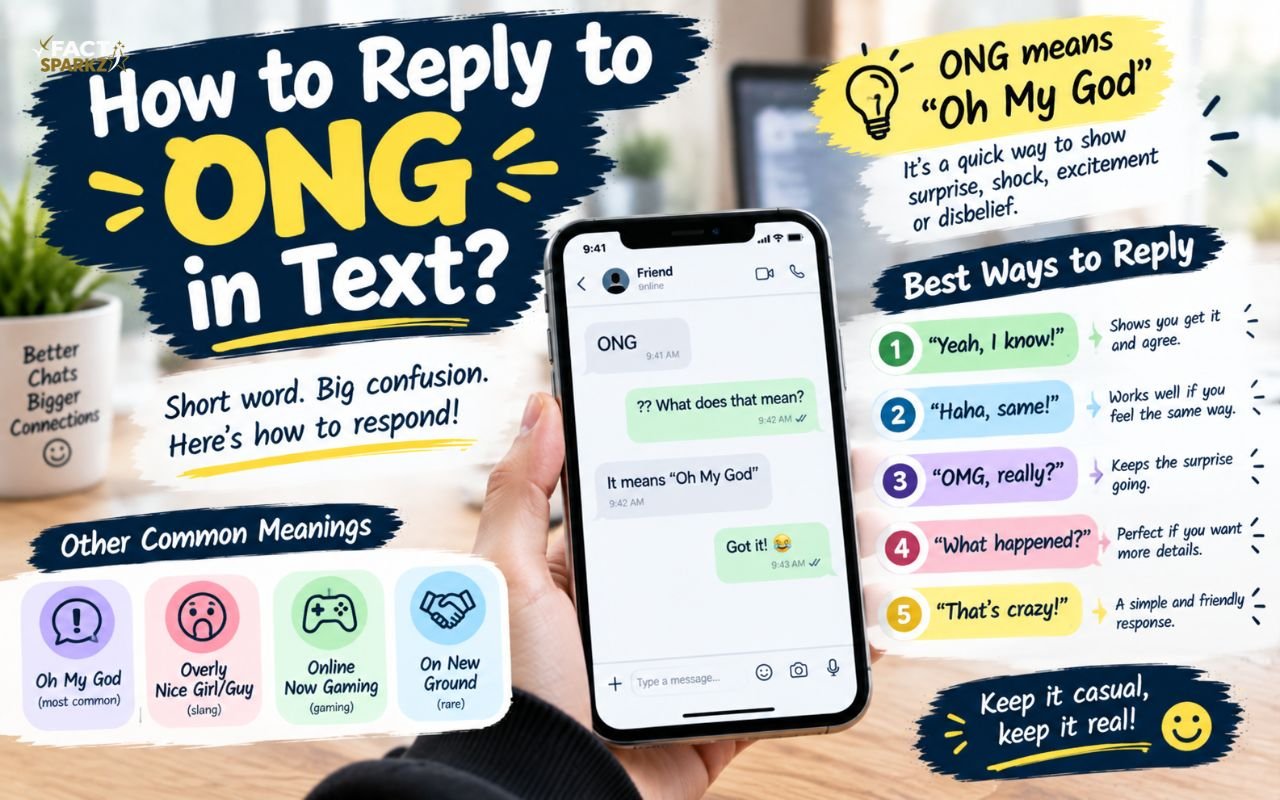
How to Reply to ONG in Text
Your response depends on what the person means.
If someone uses ONG to agree with you, you can simply continue the conversation.
Example:
Friend: “ONG that movie was amazing.”
You: “FR 😂”
If someone uses ONG to emphasize a claim, you can respond normally:
Friend: “ONG I didn’t take it.”
You: “Okay, I believe you.”
If someone says:
“ONG I’m exhausted.”
You might respond:
“Same 😭”
There is no special response required just because someone uses ONG.
The abbreviation adds tone to their message rather than creating a separate type of conversation.
Is ONG a Bad Word?
No, ONG is not generally considered a swear word.
It is an informal slang abbreviation for “On God.”
However, the expression references God, so some people may consider the phrase inappropriate in certain personal, religious, or formal settings.
Context matters.
Among friends or in casual online conversations, ONG is commonly used as slang.
In a formal email, academic assignment, professional report, or official communication, it would usually be better to use standard language instead.
Is ONG the Same as “I Swear”?
Not exactly, but the two can have similar meanings.
Both can emphasize sincerity.
For example:
“ONG, I saw him there.”
and:
“I swear, I saw him there.”
Both sentences emphasize that the speaker believes the statement is true.
However, ONG literally comes from “On God,” while “I swear” is a separate English expression.
The similarity comes from how people use both expressions to strengthen a statement.
Is ONG Used by Gen Z?
ONG is widely associated with internet slang and younger online communication, including Gen Z and other social-media users.
However, slang does not belong exclusively to one generation.
People of different ages can learn and use expressions they encounter online.
You may see ONG in:
- TikTok comments
- Instagram posts
- Snapchat chats
- Discord conversations
- Text messages
- YouTube comments
- Gaming chats
- Group messages
Its popularity comes partly from the convenience of using three letters instead of writing the complete phrase.
Is ONG the Same as OMG?
No.
Although the abbreviations look somewhat similar, ONG and OMG have completely different meanings.
ONG = On God
OMG = Oh My God
For example:
“ONG, I’m telling the truth.”
means:
“On God, I’m telling the truth.”
While:
“OMG, look at that!”
means:
“Oh my God, look at that!”
The context usually makes the difference obvious.
Examples of ONG in Texting
Here are several natural examples.
Example 1
“ONG I forgot we had homework.”
Meaning: The speaker is emphasizing that they genuinely forgot.
Example 2
“ONG this song is fire.”
Meaning: The person strongly believes the song is excellent.
Example 3
“You’re right ONG.”
Meaning: The person strongly agrees.
Example 4
“ONG I thought you were coming.”
Meaning: The speaker is emphasizing their statement.
Example 5
“ONG 😭 why did he do that?”
Meaning: The person is reacting strongly to something surprising.
Example 6
“That was crazy ONG.”
Meaning: The speaker is strongly emphasizing that the event was crazy.
Example 7
“ONG bro, you have to try this.”
Meaning: The speaker strongly recommends something.
Does ONG Always Mean “On God”?
Not necessarily.
In most modern texting and social-media contexts, ONG means “On God.”
However, abbreviations can have multiple meanings depending on the subject.
A reader should consider the surrounding words, platform, and conversation before assuming what an abbreviation means.
For example, an abbreviation used in a technical document may have a completely different meaning from the same letters used in a TikTok comment.
If you encounter ONG in a casual text or social-media conversation, though, “On God” is the most likely interpretation.
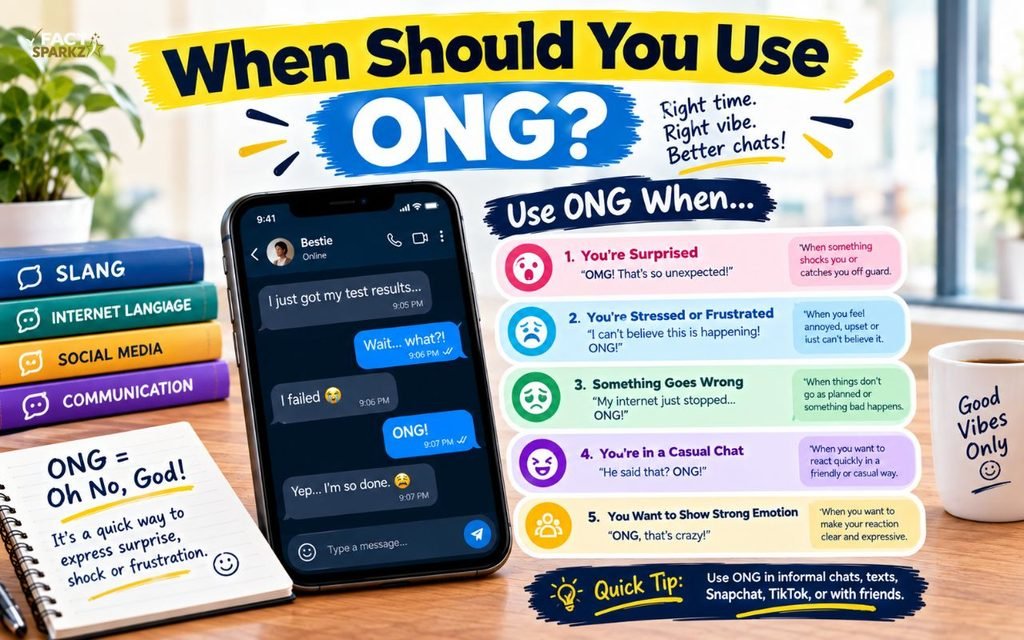
When Should You Use ONG?
ONG is best suited to informal communication.
It can work well when talking with:
- Friends
- Family members who use internet slang
- Online communities
- Gaming friends
- Social-media followers
- Group chats
It is generally less appropriate for:
- Job applications
- Business emails
- Academic assignments
- Formal reports
- Professional documents
- Official communication
For formal situations, simply write what you mean.
Instead of:
“ONG, this information is correct.”
you could write:
“I can confirm that this information is correct.”
The second version is clearer and more professional.
Why Do People Use ONG Instead of “On God”?
The main reason is convenience.
Online communication often favors short expressions.
Writing:
ONG
takes three letters.
Writing:
On God
takes six characters including the space.
Abbreviations also help create a casual tone. People who regularly communicate online may understand these shortened expressions immediately.
This is similar to abbreviations such as:
- LOL
- BTW
- IDK
- FR
- TBH
- IMO
- NGL
The abbreviation becomes part of the language style used within a particular online community.
Frequently Asked Questions About ONG
What does ONG mean in text?
ONG usually means “On God” in text messages. It is used to emphasize honesty, seriousness, agreement, or a strong reaction.
What does ONG stand for?
ONG commonly stands for “On God.”
What does ONG mean on TikTok?
On TikTok, ONG generally means “On God” and is used as an informal slang expression to emphasize a statement or reaction.
What does ONG mean in slang?
In slang, ONG means “On God.” Depending on context, it can be similar to “I swear,” “for real,” or “I’m serious.”
Is ONG a bad word?
No. ONG is not generally a swear word. It is an informal abbreviation, although some people may prefer not to use expressions involving God in certain settings.
What is the difference between ONG and FR?
ONG means “On God,” while FR means “For Real.” Both can express sincerity or agreement, but they are different abbreviations.
What is the difference between ONG and OMG?
ONG means “On God,” while OMG means “Oh My God.” They are separate slang abbreviations with different meanings.
How do you use ONG in a sentence?
You can use ONG to emphasize a statement. For example: “ONG, that was the funniest movie I’ve seen.”
Can ONG be used in formal writing?
It is better to avoid ONG in formal writing. Use standard phrases such as “I am serious,” “I genuinely believe,” or “I can confirm” instead.
Does ONG mean “I swear”?
ONG does not literally mean “I swear,” but it can be used similarly when someone wants to emphasize that they are telling the truth.
Final Thoughts
ONG meaning in text is usually “On God,” an informal expression used to emphasize sincerity, agreement, seriousness, or a strong reaction. You may encounter it in text messages, TikTok comments, Snapchat, Instagram, gaming chats, and other online conversations.
The exact tone depends on the situation. Someone might use ONG to say they are being honest, strongly agree with a friend, emphasize an opinion, or react to something surprising.
Although ONG is common in casual communication, it is not suitable for every situation. Formal emails, school assignments, business documents, and professional communication generally call for standard language.
If you see “ONG” in a casual online conversation, however, “On God” is usually the meaning you are looking for.

1 thought on “ONG Meaning in Text: 7 Clear Facts You Should Know”