
If you are searching for Connections Hint Forbes, you are probably looking for help with the daily NYT Connections puzzle without immediately seeing every answer. Forbes regularly publishes daily Connections guides containing the puzzle’s words, category hints, clues, and eventually the complete solutions.
The important thing to know is that Connections Forbes is not a separate puzzle. The phrase usually refers to Forbes’ coverage of The New York Times Connections game. The puzzle itself asks players to organize 16 words into four groups of four based on hidden connections.
In this guide, you’ll learn what the search term means, how Connections works, how Forbes-style hints are structured, how to avoid spoilers, and practical strategies for solving difficult puzzles yourself.
What Is Connections Hint Forbes?
Connections Hint Forbes is a search phrase people use when looking for Forbes’ daily coverage of the NYT Connections puzzle.
Forbes publishes recurring articles that help players work through each day’s puzzle. Its guides typically move from less revealing information toward the complete solution.
A typical guide can include:
- The day’s 16 words
- General category hints
- A clue for each group
- One answer from each category
- The four completed groups
- Explanations of difficult connections
- Discussion of misleading words or red herrings
Forbes’ current Connections coverage follows this progressive structure. Its September 2026 articles, for example, provide the daily word list and clues before revealing the complete answers.
This format is useful because you can stop reading as soon as you have enough information to finish the puzzle yourself.
Is Connections Forbes a Separate Game?
No. Connections Forbes is not a separate game created by Forbes.
The actual puzzle is Connections from The New York Times.
Forbes provides editorial coverage of the game, including daily hints and answers. Its contributor pages describe the writer’s coverage as focusing on video games and word games, while the individual articles are published as daily Connections guides.
This distinction matters when searching online.
If you search for:
Connections Forbes
you are generally looking for Forbes’ Connections guide.
If you search for:
NYT Connections
you are looking for the actual puzzle and its official game experience.
How Does NYT Connections Work?
The basic idea behind Connections is simple.
You receive a grid containing 16 words or phrases.
Your goal is to identify four groups, with four entries in each group.
Each group has a hidden relationship.
For example, four words might all relate to:
- Types of food
- Movie titles
- Words that can follow a particular term
- Items found in a specific place
The challenge is that some words are deliberately chosen to appear as though they belong to more than one group.
That creates the puzzle’s famous red herrings.
You might see four words that seem connected, but one of them actually belongs to a different category.
That is why simply finding four related words is not always enough.
You need to determine the intended connection.
Why Are Connections Puzzles Difficult?
The biggest challenge is usually not recognizing relationships.
It is deciding which relationship the puzzle creator intended.
Consider a hypothetical grid containing:
- APPLE
- ORANGE
- PEAR
- TURKEY
At first glance, APPLE, ORANGE, and PEAR clearly look like fruits.
But TURKEY could create another possible association involving food.
Now imagine several other words on the board that can also relate to fruit.
The puzzle becomes less about finding any connection and more about finding the cleanest group of four.
This is where careful elimination becomes important.
Common Sources of Difficulty
Connections can become difficult because of:
- Multiple possible meanings
- Homonyms
- Words that commonly appear together
- Pop-culture references
- Hidden words
- Prefixes and suffixes
- Famous names
- Abbreviations
- Different parts of speech
- Similar concepts
- Intentional red herrings
A strong solving strategy is therefore to avoid committing to a group too quickly.
How Forbes Connections Hints Are Usually Structured
Forbes’ daily articles generally provide help in stages.
This is useful because different players need different levels of assistance.
A player who is nearly finished might only need one category clue.
Another player may need the complete answer.
The structure can vary slightly by article, but Forbes’ current guides commonly progress from the word list to category hints, then individual answers and full solutions.
Stage 1: The Word List
The article begins by showing the 16 words.
This allows you to compare the published list with the puzzle you are playing.
Stage 2: Category Hints
Next come broader clues.
These clues give you an idea about what connects the four groups without immediately naming every answer.
For example, a hint might describe a category without explicitly listing its members.
Stage 3: One Answer From Each Group
A stronger hint may reveal one word belonging to each category.
This can be enough to help you identify the remaining three.
Stage 4: Complete Categories
The article can then reveal the category names and all four words belonging to each group.
Stage 5: Explanation
Some guides go further by explaining why the answers belong together and identifying particularly tricky red herrings. Forbes also publishes separate answer-explanation pieces that discuss how the groups fit together.
How to Use a Connections Hint Without Spoiling the Puzzle
If you enjoy solving the puzzle yourself, don’t immediately scroll to the bottom of a daily answer article.
Instead, use a progressive hint strategy.
Start With the Board
Look at all 16 words and identify obvious relationships.
Do not submit a group immediately unless you are reasonably confident.
Find the Strongest Connection
Look for four words that have an unusually specific relationship.
A category such as “types of fruit” is broad.
A category based on a particular phrase, title, or word pattern may be much stronger.
Check for Alternatives
Before selecting your four words, ask:
Could one of these words fit another group better?
This question catches many red herrings.
Use One Hint
If you get stuck, read only the broadest hint.
Return to the puzzle and try again.
Reveal One Answer
If the category hint isn’t enough, reveal one example answer.
That can dramatically narrow the possibilities without giving away everything.
Check the Full Solution Last
Only read the complete answer after you have tried the earlier steps.
This keeps the puzzle challenging while still giving you a way forward.
What Are Red Herrings in Connections?
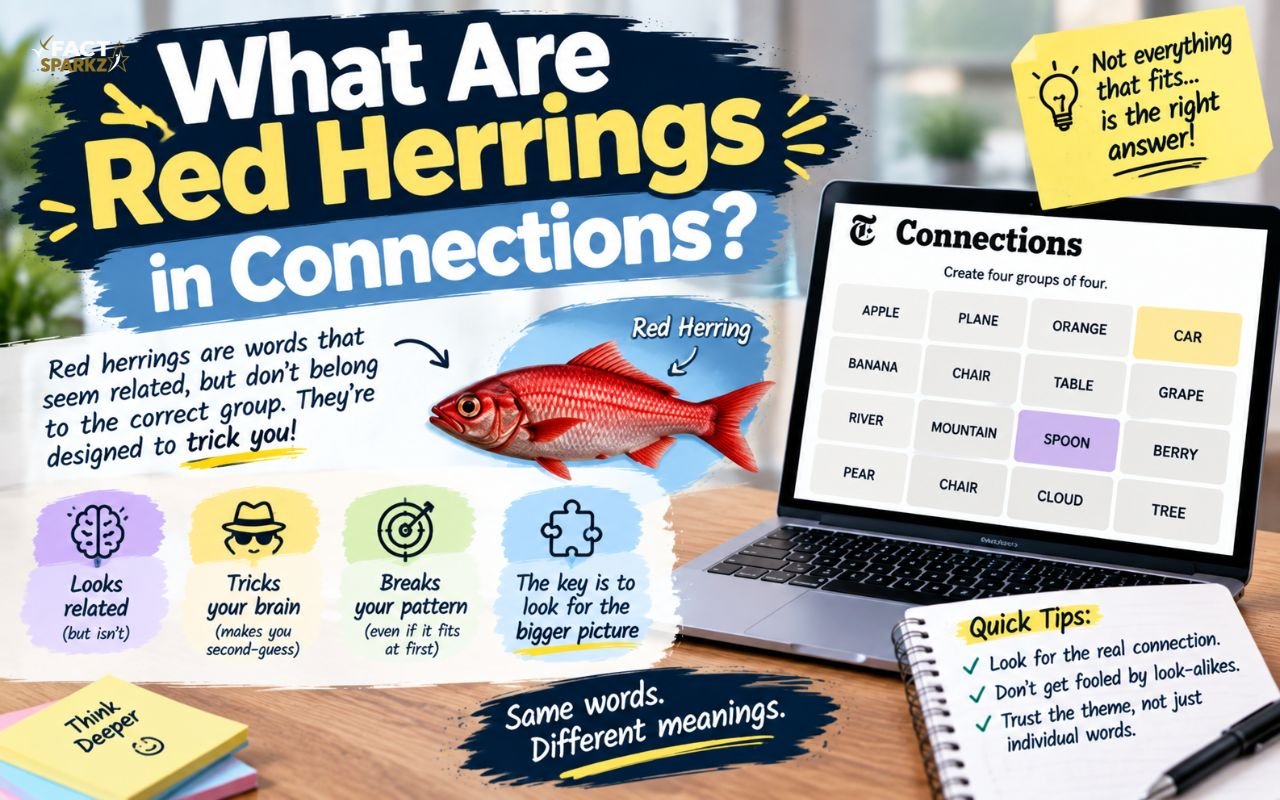
A red herring is a word that appears to belong to a category but actually belongs somewhere else.
Red herrings are one of the main reasons Connections can feel harder than it initially appears.
Imagine that three words clearly relate to a movie.
A fourth word also seems connected to that movie.
You might select all four.
But one of them could actually belong to another category, leaving you with the wrong group.
The puzzle is testing whether you can identify the intended relationship rather than simply finding something that works.
A Useful Red-Herring Question
Before submitting a group, ask:
Is this connection specific enough?
If the relationship is extremely broad, keep looking.
For example, four words that can all describe something as “good” are probably less convincing than four words that share a precise linguistic or cultural relationship.
How to Solve Connections Without Looking at Answers
You can improve your solving process with a few simple habits.
1. Look for the Obvious Group First
Some puzzles contain one category that is much easier to recognize than the others.
Finding it removes four words and simplifies the remaining board.
2. Think Beyond Literal Meanings
A word may represent:
- A person
- A place
- A title
- A verb
- A brand
- Part of a phrase
- A sound
- An abbreviation
Do not assume every connection is literal.
3. Look for Common Word Combinations
Sometimes the connection comes from words that can follow or precede the same term.
For example, several entries might become familiar phrases when paired with one particular word.
4. Watch for Word Structure
Some difficult categories involve:
- Prefixes
- Suffixes
- Hidden words
- Letter patterns
- Shared endings
- Abbreviations
If the obvious categories are not working, inspect the actual spelling.
5. Use Elimination
Once one group is confirmed, the remaining 12 words become easier to analyze.
After two groups are solved, the final eight can often reveal the remaining relationships.
Connections Hint Forbes Today: Why the Date Matters
One of the biggest issues with daily puzzle searches is that every day’s Connections puzzle is different.
Forbes publishes new Connections coverage regularly, so searching only for:
Connections Hint Forbes
may return articles from different dates.
If you want help with the puzzle you are currently solving, include the date.
For example:
Connections Hint Forbes September 24 2026
or:
Forbes NYT Connections September 24 2026
This is much more precise.
Forbes’ September 24, 2026 coverage was already publishing the next day’s article, while its September 23 article pointed readers toward the September 24 puzzle.
Why Dates Prevent Confusion
Imagine you search for “Forbes Connections today” but accidentally open an article from three days earlier.
The words will obviously be different.
You may then think the guide is incorrect when the real problem is simply that you are reading the wrong date.
Always check:
- Date
- Puzzle number
- Publication time
- Whether the page says “today”
before using a daily answer guide.
Connections Hint Forbes vs. Connections Answers
These searches can have slightly different intentions.
Connections Hint Forbes
This usually indicates that the person wants help without necessarily seeing everything.
They may want:
- Category clues
- A gentle hint
- One answer
- Help with a difficult group
Connections Answers Forbes
This generally suggests the person wants the complete solution.
They may want:
- All four categories
- All 16 answers
- An explanation
- Confirmation of their completed puzzle
If you want to preserve the challenge, always look for the hint section before the answer section.
Why People Search for Forbes Connections Guides
Daily word puzzles can become frustrating when you recognize several possible connections but cannot determine the intended groups.
A good hint can help without completely removing the challenge.
Forbes’ recurring coverage gives players different levels of assistance.
Someone who is nearly finished may only need a small clue.
Someone who has no idea where to begin can continue down the page until they reach the complete solution.
This makes the format useful for different levels of puzzle experience.
How to Search for the Right Connections Guide
If you are looking for a particular day’s puzzle, use a specific search query.
Try:
“Connections Hint Forbes today”
For a specific date:
“Connections Hint Forbes September 24 2026”
For the complete answer:
“Connections Answers Forbes September 24 2026”
For the official game:
“NYT Connections today”
Including the date is usually the safest approach when searching for archived puzzle coverage.
Should You Read the Answers Before Playing?
That depends on what you want from the puzzle.
If your goal is simply to know the solution, reading the answers immediately is fine.
If you enjoy the challenge, start with the lightest hint available.
A good progression is:
No hint → broad category clue → one-word clue → one answer → complete category → full solution.
This lets you choose the amount of help you need.
It also prevents the common mistake of accidentally reading the complete answer when you only wanted a small nudge.
Tips for Better Connections Results
Here are several practical habits that can improve your solving ability.
Don’t Force a Group
If you need to stretch the explanation to make four words fit, the group may be wrong.
Consider Multiple Meanings
A word can be a noun, verb, name, title, place, or part of a phrase.
Look at the Remaining Words
Sometimes the best way to identify one group is to determine what the other words clearly cannot be.
Be Careful With Famous Names
A group may contain words that look like names or titles even when that is not their intended relationship.
Check Spelling
Some categories depend on letters rather than meanings.
Don’t Ignore the Hardest Group
The final purple group is often more wordplay-heavy or indirect, so save it until you have eliminated easier possibilities.
Is Forbes the Creator of NYT Connections?
No.
The New York Times is the publisher of the Connections game.
Forbes is a publication that provides editorial coverage of the puzzle, including hints and answers. Forbes’ current pages explicitly frame these articles as coverage of the NYT Connections game.
This distinction is important because searches for “Connections Forbes” can make it sound like Forbes operates the puzzle itself.
It does not.
Frequently Asked Questions
What does Connections Hint Forbes mean?
Connections Hint Forbes usually refers to Forbes’ daily hint articles for the New York Times Connections puzzle. These guides can include clues, categories, answers, and explanations.
Is Connections Forbes a separate game?
No. Connections Forbes is not a separate game. It generally refers to Forbes’ coverage of the NYT Connections puzzle.
Where can I find Forbes Connections today?
Search for the current date together with Connections Forbes or Forbes NYT Connections. Including the date helps you avoid opening an older daily guide.
Does Forbes give Connections hints?
Yes. Forbes regularly publishes daily Connections guides containing hints and, later in the article, the complete answers.
Does Forbes show the full Connections answers?
Yes. Its daily guides can progress from the word list and hints to the complete categories and answers.
What are Connections red herrings?
Red herrings are words that appear to belong to one category but actually belong to another. They are used to make the puzzle more challenging.
How many words are in NYT Connections?
A standard Connections puzzle contains 16 entries, which must be divided into four groups of four.
How many categories are in Connections?
There are four groups, with four entries in each group.
How can I get a Connections hint without seeing the answer?
Read only the broad category hints or one-word clues, then return to the puzzle. Avoid scrolling into the full-answer section until you need it.
Why should I include the date when searching for Connections hints?
Because the puzzle changes daily. A search that does not include the date can lead you to an older Forbes guide with a different word grid.
Is Forbes’ Connections coverage updated every day?
Forbes regularly publishes new daily Connections coverage. Its September 2026 archive shows recurring guides across different puzzle dates.
Final Thoughts
Connections Hint Forbes is primarily a search phrase for players looking for Forbes’ daily help with the New York Times Connections puzzle.
Forbes’ guides can be useful because they generally allow players to choose how much assistance they want. You can start with the word list, look at broad category clues, reveal a single answer, or continue to the complete solution.
The most important thing is to check the date before using a daily guide. Since Connections changes every day, an older article will contain a completely different puzzle.
If you want to preserve the challenge, use hints gradually instead of jumping straight to the answers. Look for specific relationships, watch for red herrings, consider alternative meanings, and use elimination after solving each group.
And remember: Forbes does not create the Connections puzzle. The search term refers to Forbes’ editorial coverage of the NYT game.
Whether you need one small clue or the complete solution, understanding how these guides work can make it easier to find the right level of help without spoiling more of the puzzle than necessary.

1 thought on “Connections Hint Forbes: Complete Guide to Hints, Clues & Answers”