
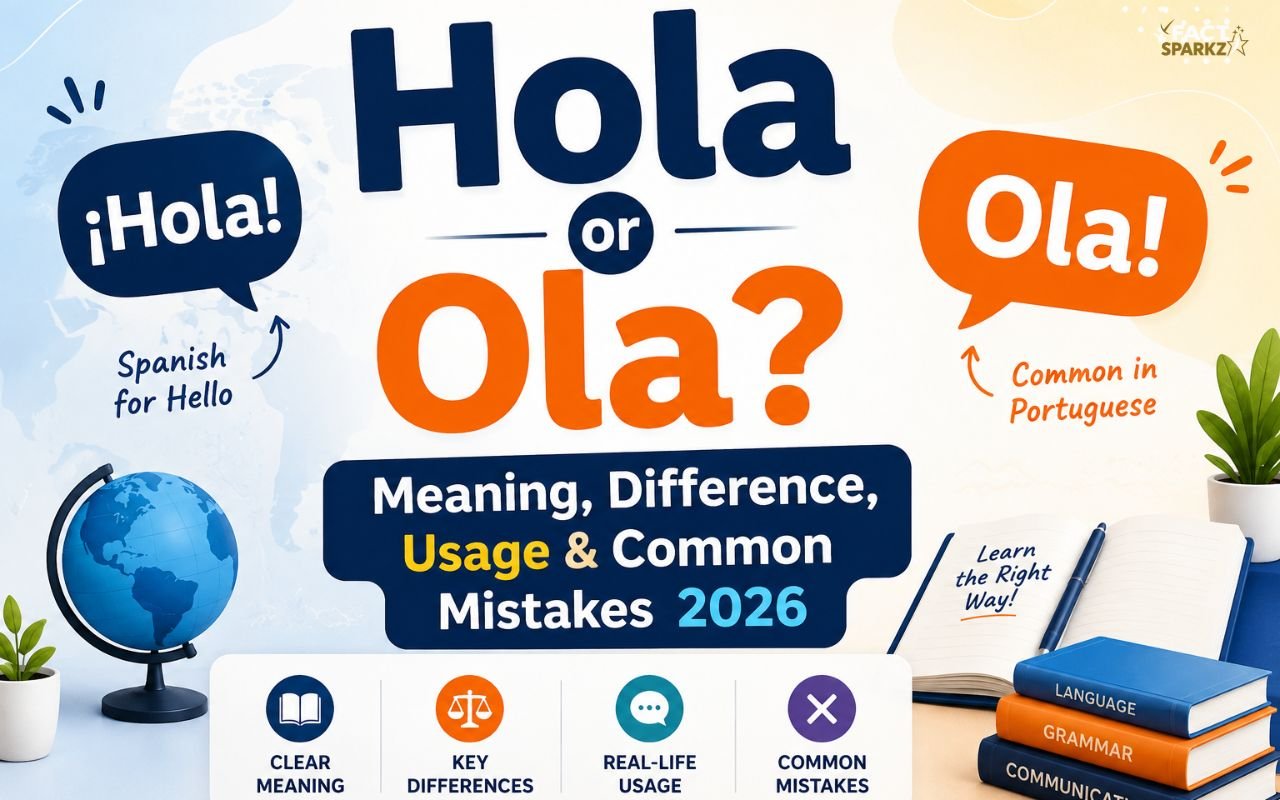
When you see hola or ola, the difference may seem confusing because both words sound almost identical in Spanish. However, their meanings are completely different. Hola means “hello” and is one of the most common Spanish greetings used in everyday conversations. Ola, on the other hand, means “wave,” especially when talking about the ocean or water.
The confusion happens mainly because Spanish has a silent H, so the H in hola is not pronounced. In this guide, you’ll learn the difference between hola and ola, how to pronounce both words correctly, when to use each one, and how to avoid common spelling mistakes when communicating in Spanish.
Hola or Ola: What Is the Difference?
The simplest answer is that hola vs ola is a difference in both spelling and meaning. Hola means “hello” and works as a Spanish greeting. Ola, on the other hand, means “wave,” such as a wave in the sea. If you are wondering what does hola mean, the answer is simple: it is the standard Spanish word for hello. If you are asking what does ola mean, it means a wave.
The correct spelling of hola matters because writing “ola” when greeting someone changes the meaning. The words may sound alike, but they are used in completely different situations. This is why learning Spanish greetings and meanings is helpful for anyone starting with the language.
| Word | Meaning | Language | Example |
| Hola | Hello | Spanish | Hola, ¿cómo estás? |
| Ola | Wave | Spanish | La ola es grande. |
| Olá | Hello | Portuguese | Olá, tudo bem? |
What Does Hola Mean?
The hola meaning is “hello” or “hi.” It is one of the first basic Spanish words that most learners study. You can use it with friends, family, classmates, coworkers, and people you meet for the first time. It is simple, friendly, and widely understood throughout the Spanish-speaking world.
If you want to know how to say hello in Spanish, hola is usually the easiest answer. Some common hola examples include “Hola, Maria,” “Hola, ¿cómo estás?” and “Hola a todos.” The word works naturally in person, in text messages, on phone calls, and in a normal Spanish conversation.
What Does Ola Mean?
The ola meaning is completely different. Ola in Spanish means a wave, usually a movement of water. It is the Spanish word for wave, so you might see it when reading about the sea, surfing, or the beach. For example, “La ola fue enorme” means “The wave was huge.”
An ocean wave in Spanish can be called una ola. This makes it easy to remember when to use ola. If the sentence is about water or waves, ola may be correct. If you are greeting someone, you need hola.
When Should You Use Hola and Ola?
Knowing when to use hola is easy once you connect it with greetings. Use hola when saying hello, beginning a conversation, answering a call, or sending a friendly message. It fits naturally into many casual Spanish greetings and can also work in neutral or semi-formal situations.
Knowing when to use ola is equally simple. Use ola when discussing a wave. A sentence about the ocean, beach, sea, or water may use this word. The spelling may differ by only one letter, but the meaning changes completely.
Use Hola When Greeting Someone
You can use hola usage in many situations. Imagine walking into a classroom and saying, “Hola, everyone.” You can greet a friend with “Hola, ¿qué tal?” or begin a message with “Hola, ¿cómo estás?” These examples show how natural hola feels in everyday communication.
For beginners learning Spanish vocabulary for beginners, hola is an excellent starting point. It is one of the most useful Spanish greeting words because you will hear and use it often.
Use Ola When Talking About a Wave
Use ola when the subject involves water. For example, “La ola llegó a la playa” means “The wave reached the beach.” In this context, using hola would be incorrect because the sentence is not about greeting anyone.
A simple memory trick can prevent many Spanish language mistakes: greeting someone equals hola, while seeing a wave equals ola. Once you connect ola with the ocean, the spelling becomes easier to remember.
Why Do Hola and Ola Sound the Same?
The main reason hola or ola creates confusion is pronunciation. In standard modern Spanish, the H at the beginning of hola is silent. Therefore, hola is pronounced similarly to ola. This makes them examples of Spanish homophones, or words that can sound the same while having different meanings.
The surrounding sentence usually tells you which meaning is intended. Context is extremely important when learning languages. A person saying “Hola, Ana” is clearly greeting Ana. A person saying “La ola es enorme” is talking about water. Understanding context helps learners avoid common Spanish mistakes.
Why Is the H Silent in Spanish?
The silent H in Spanish surprises many English speakers because English often gives H a clear sound. However, the H in hola is not pronounced like the H in “house” or “hello.” You simply begin with the vowel sound.
This is one reason Spanish pronunciation can feel unfamiliar at first. Many learners see the spelling and instinctively say “HO-la.” Native Spanish pronunciation does not normally pronounce the H in that way.
Understanding Spanish Homophones
Spanish homophones are words that share the same or very similar pronunciation but have different spellings and meanings. Hola and ola are a useful example because their difference is easy to understand through context.
There are other words that sound the same in Spanish or sound very similar in certain contexts. Learning them takes practice, but reading and writing complete sentences can help you remember which spelling belongs to which meaning.
How to Pronounce Hola and Ola Correctly
If you are learning how to pronounce hola, think of it roughly as “OH-lah.” The first syllable receives the natural stress, while the H remains silent. The sound should flow smoothly instead of beginning with a strong English H.
The hola pronunciation and ola pronunciation are similar because the written H in hola is silent. This similarity explains why learners sometimes confuse them. However, correct spelling still matters because the listener may understand the spoken context, while a reader only sees the written word.

Common Pronunciation Mistakes
One of the most frequent mistakes is saying “HO-la” with a strong H sound. Another mistake is stressing the final syllable too heavily. Spanish pronunciation usually follows more predictable patterns than English, so listening to native speakers can help you develop a more natural rhythm.
The best approach is simple: hear the word, repeat it, and use it in complete sentences. Practice turns difficult spelling or pronunciation rules into something automatic.
Common Mistakes When Using Hola and Ola
The most common error is writing “Ola, how are you?” when you mean “Hello.” This is understandable because the words sound alike, but it is still incorrect in Spanish. The correct version is “Hola, ¿cómo estás?”
Other common Spanish mistakes happen when learners apply English spelling habits to Spanish. Some people pronounce the H, while others add an accent and write holá. Standard Spanish uses hola, without an accent.
Writing “Ola” When You Mean “Hello”
If you are greeting a person, always write hola. Writing ola changes the meaning to “wave.” This is one of the easiest Spanish language mistakes to fix because the rule is clear once you understand the two meanings.
Think about the situation before writing. Are you saying hello, or are you describing water? That quick question can solve the problem.
Thinking the H in Hola Is Pronounced
English speakers often expect every written H to make a sound. In Spanish, that expectation can create pronunciation errors. Remember that the H in hola is silent.
Learning this small rule can also make other Spanish words easier to understand. As your knowledge grows, you will begin to recognize common pronunciation patterns more naturally.
What About “Olá” in Portuguese?
The word Portuguese olá adds another interesting layer to the confusion. In Portuguese, olá means “hello.” Unlike Spanish hola, it does not use an H. It also includes an accent mark.
This creates the important comparison of hola vs olá. Spanish uses hola for “hello,” while Portuguese uses olá. Spanish ola, without an accent, means “wave.” Understanding these differences is useful when learning Spanish and Portuguese greetings.
| Word | Language | Meaning |
| Hola | Spanish | Hello |
| Ola | Spanish | Wave |
| Olá | Portuguese | Hello |
The language matters as much as the spelling. Someone writing Olá! may be greeting you in Portuguese, while someone writing Hola! is greeting you in Spanish. This is a good example of how small spelling details can carry important meaning.
How Is Hola Used in Real Conversations?
In everyday speech, hola in conversation is flexible and natural. Friends can say “Hola” when they meet. Someone can begin a phone call with it. A text message may simply say “Holaaa” with extra letters to create a playful tone.
These uses show that hola works well in normal communication. It is common in informal Spanish greetings, but it can also appear in neutral settings. Tone and the rest of the sentence help determine how formal or relaxed the conversation feels.
Casual Greetings
Among friends, hola can stand alone or appear with another phrase. “Hola, ¿qué tal?” means something close to “Hi, how’s it going?” A person might also write “Holaaa!” when feeling excited.
This flexibility makes hola useful for everyday conversations. It is short, easy to remember, and familiar across Spanish-speaking communities.
Social Media and Online Chats
The word also appears frequently in online communication. You may see it in direct messages, comments, captions, gaming chats, or videos. This is one reason hola has become one of the recognizable Spanish words used in English and international internet culture.
In bilingual spaces, people sometimes mix languages naturally. A creator might say, “Hola, guys!” before continuing in English. This type of bilingual communication is common when both languages are familiar to the audience.
Formal and Semi-Formal Situations
Hola is friendly, but the rest of the conversation can become more formal depending on the setting. In professional situations, speakers may choose greetings such as Buenos días or Buenas tardes when a more polite tone is needed.
These are examples of formal Spanish greetings. Learning the difference between casual and formal language helps you choose the right greeting for the situation.
How Do You Respond to Hola?
If you are wondering how to respond to hola, the easiest answer is to say “Hola” back. You can then continue the conversation with a question such as “¿Cómo estás?” or “¿Qué tal?”
A natural reply to hola depends on your relationship with the speaker and the situation. “Hola, ¿cómo estás?” is friendly and common. “Bien, gracias. ¿Y tú?” means “Fine, thanks. And you?”
The important thing is not to overthink it. Most Spanish greetings for beginners follow simple patterns. Start with a greeting, ask how the person is doing, and respond naturally.
Related Spanish Greetings You Should Know
Learning hola is only the beginning. There are many other useful Spanish greetings and meanings that can help you feel more comfortable in conversation. Buenos días means “good morning.” Buenas tardes is commonly used during the afternoon, while buenas noches can mean “good evening” or “good night,” depending on the context.
You may also hear ¿Qué tal?, an informal question similar to “How’s it going?” Another common phrase is ¿Cómo estás?, which means “How are you?” Together, these phrases create a strong foundation for Spanish greetings for beginners.
| Spanish Greeting | Common English Meaning | Typical Use |
| Hola | Hello | General greeting |
| Buenos días | Good morning | Morning |
| Buenas tardes | Good afternoon | Afternoon |
| Buenas noches | Good evening/night | Evening or night |
| ¿Qué tal? | How’s it going? | Informal |
| ¿Cómo estás? | How are you? | Friendly conversation |
These expressions can make your Spanish conversation feel more natural. Instead of repeating hola every time, you can choose a greeting that better matches the time, tone, and relationship.

How to Remember the Difference Between Hola and Ola
The easiest memory trick is to connect the H in hola with the H in “hello.” Hola means hello, even though the H is silent. Then connect ola with the ocean. An ola is a wave.
You can practice with short sentences. “___, Maria!” needs Hola. “The huge ___ reached the beach” refers to ola. This simple contrast makes the difference between hola and ola easier to remember.
The best learning method is repetition with context. Read the words, say them aloud, and write your own examples. After a little practice, deciding between hola or ola becomes almost automatic.
Frequently Asked Questions About Hola and Ola
What is the full meaning of hola?
Hola means “hello” or “hi” in Spanish. It is a common greeting used to start a conversation.
What does “hola” mean in slang?
Hola is not really slang; it is a standard Spanish greeting. In casual chats, people may write “holaaa” to sound more playful or friendly.
Is hola a Mexican word?
No. Hola is a standard Spanish word used throughout Mexico, Spain, and other Spanish-speaking countries.
What does “hola” mean in Spanish?
In Spanish, hola means “hello” or “hi.” It is one of the most common everyday Spanish greetings.
Do Spanish people actually say hola?
Yes. Spanish speakers commonly say hola when greeting friends, family, coworkers, and other people in everyday situations.
What can I say instead of hola?
You can use buenos días, buenas tardes, buenas noches, or the casual ¿qué tal?, depending on the time and situation.
Final Thoughts
The confusion between hola vs ola is easy to understand, but the solution is simple. Hola means hello and is used as a greeting. Ola means wave and refers to water. The silent H makes them sound alike, but their spelling and context reveal their true meaning.
Whether you are learning Spanish, traveling, practicing English and Spanish conversation, or simply improving your Spanish vocabulary for beginners, remembering this distinction will help you communicate more clearly. Think H for Hello and Ola for Ocean, and you will always know which word to use.
Latest Posts
- Vencoing Com Guide: Features, Uses, and Key Information
- Startupbooted.com Review: Exploring Its Purpose, Features, and User Experience
- US Travel Destinations: 15 Best Places to Visit in the United States
- Consoles Gaming Eurogamersonline: Gaming Features, Accessories, and Setup Tips
- 2579xao6 New Software Name Overview: Purpose, Uses, and Benefits

3 thoughts on “Hola or Ola? Meaning, Difference, Usage & Common Mistakes 2026”