

Confused by Emasculate vs. Demasculate? You’re not alone. These two words look closely related, yet they don’t carry the same weight in standard English. Understanding the emasculate meaning can help you avoid awkward wording in essays, workplace communication, and everyday writing. While emasculate has established literal and figurative meanings, demasculate appears far less often and can raise questions about correctness.
The confusion usually comes from the de- prefix, which makes the second form seem logical at first glance. In this guide, you’ll learn the difference between emasculate and demasculate, explore real examples, and discover how to use emasculate naturally. By the end, choosing the correct term will feel simple.
Emasculate vs. Demasculate: What’s the Difference?
The emasculate vs demasculate difference becomes simple once you look at established English usage. Emasculate is a recognized verb. It can mean to deprive something of strength or effectiveness, make a man feel less masculine, or describe a biological process. Oxford and Merriam-Webster both record these established senses.
So, what is the difference between emasculate and demasculate? In standard American English, emasculate is the established choice. Demasculate does appear in some online and specialist word resources, but it isn’t listed by the major dictionaries checked here. That makes it a poor choice for professional writing, academic work, or polished published content.
| Feature | Emasculate | Demasculate |
| Standard dictionary status | Established | Not listed by major dictionaries checked |
| Main use | Weaken, deprive of masculine qualities, or castrate | Occasional nonstandard formation |
| Formal writing | Appropriate when context fits | Best avoided |
| Scientific usage | Established | Not standard |
| Common recommendation | Use it | Choose a clearer established word |
The safest rule is simple: use emasculate when you need the established English verb.
What Does “Emasculate” Mean?
The emasculate definition has more than one layer. In its literal sense, it can mean to castrate or remove male reproductive capability. Merriam-Webster also records a botanical sense involving removal of the androecium from a flower during controlled cross-pollination.
In modern writing, the figurative meaning of emasculate often matters more. It can describe something that makes a person feel less powerful or masculine. It can also describe something that reduces the effectiveness of a law, institution, recommendation, or policy. Cambridge and Oxford both document this broader usage.
Emasculate: Literal and Figurative Meanings
The emasculate literal meaning belongs mainly to biological or historical contexts. It relates to castrate, male reproductive organs, and surgical removal. In a medical context or veterinary context, the term can describe the removal of male reproductive capability.
The emasculate figurative meaning is broader. Someone can feel emasculated when circumstances damage their confidence, authority, independence, or sense of masculine identity. The word can also describe an institution losing power. That distinction matters because context determines the intended semantic meaning.
What Does Emasculate Mean in Simple Terms?
If you ask, “what does emasculate mean in simple terms?” think of the core idea as removing strength or effectiveness. The exact kind of strength changes with context. It might involve physical capability, personal confidence, institutional authority, or the effectiveness of an idea.
For example, “The amendment emasculated the law” means the amendment made the law less effective. Meanwhile, “He felt emasculated after losing control of the project” describes a personal reaction. These examples show why contextual meaning matters.
Where Does the Word “Emasculate” Come From?
The linguistic roots of emasculate reach back to Latin. Oxford traces the word to the early 17th century and identifies the Latin emasculatus as its source. Merriam-Webster gives 1607 as its first known English use.
The Latin origin helps explain the word’s structure. Emasculatus came from emasculare, related to masculus, meaning male. This history explains the connection with masculine vigor and virility. However, modern English has expanded the word beyond its original physical sense.
When Did Emasculate Enter English?
If you search for when did emasculate enter the English language, you may find slightly different dates. Merriam-Webster gives 1607 as its first known use, while Oxford describes it as an early-17th-century word.
That small difference doesn’t change the main point. The word has been part of English for centuries. Its documented usage shows a long-established history, while its figurative applications developed alongside broader changes in English expression.
| Stage | Development |
| Latin | emasculatus related to male or castrated |
| Early 17th century | Enters recorded English usage |
| Later English | Literal and figurative senses develop |
| Modern English | Also used for effectiveness, authority, and botany |
How Is “Emasculate” Used in Different Contexts?
The emasculate usage becomes much clearer when you separate its contexts. In biology, the word can describe removing male reproductive structures. In botany, it has a precise technical meaning. In everyday and professional language, it often describes weakening power, effectiveness, or confidence.
This range makes the word unusually versatile. You might encounter it in academic writing, legal analysis, workplace discussions, political commentary, or literature. Still, the figurative sense can carry emotional weight, so writers should choose it carefully when discussing people.

Emasculate in Biology and Medicine
The emasculate medical meaning relates to castration or removal of male sexual structures. Cambridge identifies this as a specialized biological sense. In veterinary writing, for example, the term can describe a male animal undergoing a procedure that removes reproductive capability.
This is where literal usage matters most. A scientific reader expects precise terminology rather than metaphor. In ordinary conversation, however, people rarely use emasculate to discuss medical procedures. More direct clinical terms are usually clearer.
Emasculate in Botany
Botany gives emasculate another specialized meaning. During artificial cross-pollination, a breeder can remove the male reproductive parts of a flower before pollen is released. Merriam-Webster specifically records this use.
The purpose is controlled breeding. Removing the flower’s male structures helps prevent unwanted self-pollination. The breeder can then introduce pollen from a chosen plant. Here, emasculate has nothing to do with confidence or social power. It describes a precise biological action.
Emasculate in Social and Professional Contexts
The figurative use appears frequently in discussions about personal power, leadership, confidence, and authority. A manager might describe a policy as weakening a department’s decision-making ability. A writer might say criticism emasculated creativity when excessive restrictions drained its original force.
The same pattern appears in politics. A law can be described as emasculated when later changes remove much of its original force. Merriam-Webster specifically records this broader sense of depriving something of force or effectiveness.
What Does “Demasculate” Mean?
The demasculate meaning creates the most uncertainty because the form looks perfectly plausible. English has many words beginning with the prefix “de-”, including deactivate, defrost, and devalue. That pattern can make demasculate feel like an obvious construction.
However, major dictionaries checked for this article list emasculate, not demasculate, as the established verb. Wiktionary does record demasculate as an English verb meaning to remove masculinity, which shows that the form exists in some lexical resources. It doesn’t give the term the same mainstream status as emasculate.
Is Demasculate a Word?
So, is demasculate a word? The most accurate answer needs nuance. It exists as a recorded English formation in some resources, but it isn’t a standard mainstream dictionary choice. Merriam-Webster, Oxford, and Cambridge entries for the relevant verb use emasculate.
That distinction is important. Saying “it doesn’t exist anywhere” is too absolute. Saying “it is fully standard English” is also misleading. For polished American English, standard usage favors emasculate. If you want maximum clarity, use emasculate or choose a more precise synonym.
Why Does Demasculate Sound So Natural?
The confusion comes from word formation. Readers often assume that adding a word prefix such as de- should create the opposite or reverse meaning. English sometimes works that way. It doesn’t work mechanically in every case.
Here, the extra prefix can feel unnecessary because emasculate already carries the idea of removal or weakening. That makes demasculate resemble an invented counterpart. Language doesn’t always reward perfect-looking formulas. Sometimes historical usage wins the argument.
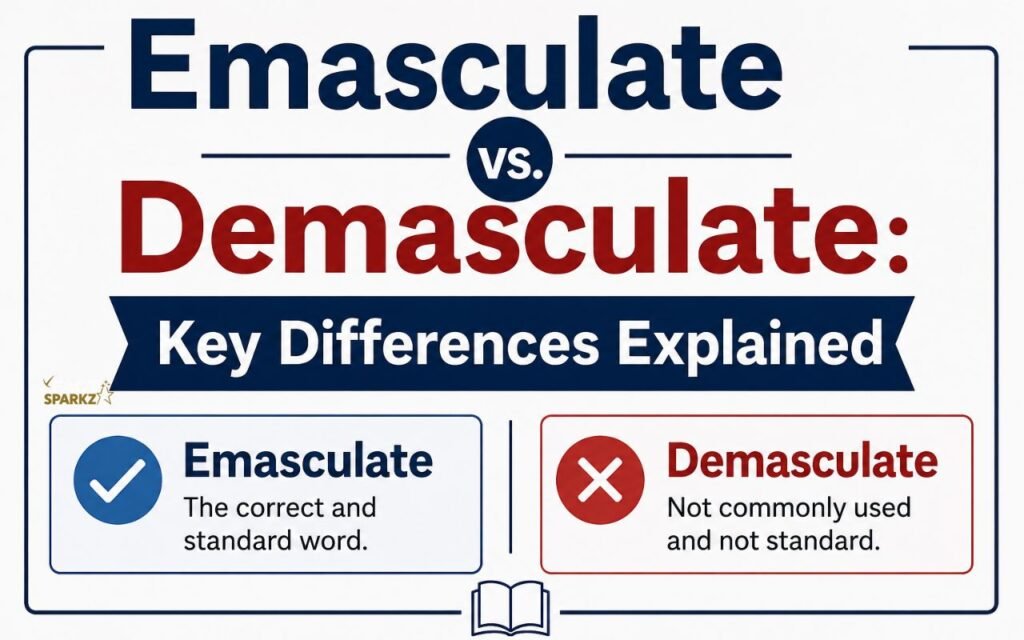
Emasculate vs. Demasculate: Key Differences Explained
The clearest emasculate vs demasculate difference concerns standardness and context. Emasculate has centuries of recorded English usage and appears in major dictionaries. It also has several established meanings. Demasculate appears far less often and lacks comparable mainstream dictionary coverage.
That doesn’t mean every appearance of demasculate is meaningless. A reader can often understand what the writer intends. Still, understandable doesn’t automatically mean conventional. For formal writing, the established word remains the better choice.
| Meaning or Use | Emasculate | Demasculate |
| Weaken effectiveness | Established | Nonstandard |
| Reduce authority | Established | Nonstandard |
| Affect masculine identity | Established | Occasional |
| Biological use | Established | Not standard |
| Botanical use | Established | Not standard |
| Professional writing | Recommended | Avoid |
| Major dictionary support | Yes | No comparable coverage |
A useful correct word emasculate rule is this: when you mean established weakening or loss of masculine power, choose emasculate. When you simply mean “make weaker,” another plain verb may be even better.
Verb Forms of Emasculate
The verb forms of emasculate are straightforward. The base form is emasculate. The past form and past participle are emasculated. The present participle is emasculating. Oxford lists these forms directly.
| Verb Form | Example |
| Emasculate | Criticism can emasculate creative work. |
| Emasculated | The amendment emasculated the proposal. |
| Emasculating | Constant interference became emasculating. |
These forms follow normal English grammar. The spelling does not change unpredictably. That makes emasculate easier to use once you understand its meaning.
Why Do People Confuse “Emasculate” and “Demasculate”?
The confusion isn’t surprising. English contains thousands of words with productive-looking prefixes. When readers see emasculate, they may mentally connect it with masculine. From there, demasculate seems like a logical way to express removal of masculinity.
Yet word formation isn’t simple mathematics. English contains historical leftovers, borrowed forms, irregular patterns, and words whose structures no longer behave predictably. That is why a word can look logical and still sound unusual to experienced speakers.
The Prefix Trap
The prefix “de-” often suggests reversal, removal, or reduction. Words such as deactivate and defrost reinforce that pattern. A learner may therefore assume that demasculate must be the correct form.
That assumption creates vocabulary confusion. The established verb already handles the relevant meaning. Major dictionaries define emasculate as weakening or depriving of strength and also record its biological sense.
Why Online Usage Adds Confusion
Online language changes quickly. A word can appear in social posts, forums, comments, or informal articles before readers check a dictionary. Repetition can then make an unusual form seem familiar.
For language learners, this creates a special problem. Familiarity and correctness aren’t identical. If your goal is polished American English, prioritize established dictionary usage and the context of your sentence.
How to Use “Emasculate” Correctly in a Sentence
Learning how to use emasculate is easier when you start with the meaning you intend. If something loses effectiveness, emasculate can work. If someone feels stripped of confidence or masculine identity, it can also work. Oxford and Cambridge both document these figurative patterns.
The word is formal and can sound strong. Before using it, ask whether a simpler verb would communicate your idea better. Sometimes weaken, undermine, or diminish says exactly what you mean without carrying the same social or emotional weight.
Emasculate in a Sentence
Here are natural emasculate examples that show different meanings:
| Context | Example |
| Workplace | Constant micromanagement can emasculate a creative team. |
| Politics | The amendment emasculated the agency’s enforcement powers. |
| Writing | Heavy editing emasculated the story’s original voice. |
| Confidence | Public humiliation left him feeling emasculated. |
| Science | Researchers emasculated the flowers before controlled pollination. |
These examples show why the word isn’t limited to people. A law, organization, policy, creative work, or flower can also be described using the verb.
Common Usage Errors
One common spelling mistake is confusing emasculate with immaculate. They look somewhat similar, but their meanings have nothing in common. Immaculate means perfectly clean or flawless. Emasculate concerns weakening, removing male reproductive capability, or reducing effectiveness.
Another mistake is choosing emasculate whenever you simply mean “hurt.” That can make your sentence too dramatic. Strong vocabulary works best when it matches the precise idea.
Is Emasculate Only Used for Men?
The answer requires context. The traditional masculine sense naturally relates to men. However, dictionaries also record figurative uses involving reduced effectiveness or power. Cambridge notes that emasculate can describe something becoming less effective, while Oxford includes a broader “less powerful or less effective” sense.
Therefore, does emasculate only apply to men? No, not when the word describes an institution, policy, idea, or other nonhuman subject. When describing a person’s gender identity or masculine role, however, the word carries a more specific implication.

Better Alternatives to “Demasculate”
Sometimes the best alternative isn’t emasculate at all. If you mean “make weaker,” use weaken. If you mean “damage someone’s authority,” use undermine. If you mean “reduce importance,” use diminish. These choices often produce clearer business communication and professional writing.
Choosing a synonym also helps avoid unnecessary ambiguity. For example, “The cuts weakened the department” is immediately clear. “The cuts emasculated the department” is more vivid and formal. Both can work, but the second carries a stronger rhetorical flavor.
| What You Mean | Better Choice |
| Reduce strength | Weaken |
| Damage authority | Undermine |
| Reduce importance | Diminish |
| Remove power | Disempower |
| Reduce effectiveness | Weaken or impair |
| Affect masculine identity | Emasculate |
Emasculate Synonym Choices
The best emasculate synonym depends on your intended meaning. Weaken works for general loss of strength. Undermine suits authority or confidence. Disempower emphasizes loss of agency. Diminish sounds measured and often fits formal prose.
For academic writing, precision usually beats drama. For literary writing, emasculate may create a sharper image. The key is to select the word that expresses the exact relationship between the cause and the effect.
What Is the Opposite of Emasculate?
If you search for what is the opposite of emasculate, several answers can work. Empower, strengthen, fortify, and invigorate can all express an opposing idea, depending on context.
There isn’t one universal antonym. If a policy becomes stronger, say it was strengthened. If someone regains confidence, say they were empowered. If an institution gains authority, say its powers were reinforced.
Quick Decision Guide: Emasculate or Demasculate?
When choosing between the two, don’t let spelling alone make the decision. Emasculate is the established mainstream choice. Demasculate appears in some lesser-used lexical resources, but major dictionaries do not give it equivalent status.
Therefore, if you’re writing for a U.S. audience, use emasculate in formal, academic, professional, or editorial work. If your intended meaning is simply “weaken,” consider that simpler word instead. Clear writing isn’t about using the fanciest term. It’s about choosing the exact one.
A Simple Decision Table
| If you mean… | Choose… |
| Make something less effective | Emasculate |
| Weaken authority | Emasculate or undermine |
| Reduce confidence | Emasculate or undermine |
| Remove male reproductive capability | Emasculate |
| Describe flower emasculation | Emasculate |
| Simply make weaker | Weaken |
| Simply reduce importance | Diminish |
| Use “demasculate” in formal writing | Avoid it |
Final Verdict on Emasculate vs. Demasculate
The emasculate vs demasculate difference is mainly a matter of established usage. Emasculate is a long-standing English verb with recognized literal, figurative, biological, botanical, and institutional meanings. Major dictionaries document those senses clearly.
Demasculate is more complicated than simply calling it “not a word.” Some lexical resources record it, but it lacks the mainstream dictionary standing of emasculate. For polished American English, emasculate is the dependable choice. When a simpler meaning fits, use weaken, undermine, or diminish instead.
Frequently Asked Questions About Emasculate vs. Demasculate
Is It “Emasculating” or “Demasculating”?
Emasculating is the standard and widely established form. It describes something that makes a person feel less powerful, confident, masculine, or in control. “Demasculating” may appear occasionally, but it isn’t the preferred choice in standard English.
What Does “Emasculating” Mean?
Emasculating means causing someone to feel less powerful, confident, or masculine. It can also describe something that weakens authority or effectiveness. For example, constant public criticism can feel emasculating because it may reduce someone’s sense of confidence or control.
What Does “Demasculinize” Mean?
Demasculinize means to make someone or something less masculine. The term exists but remains uncommon compared with emasculate. In most everyday, professional, or formal writing, choose the word that best describes the specific change you mean.
How Do You Spell “Demasculate”?
The spelling is demasculate: D-E-M-A-S-C-U-L-A-T-E. However, spelling it correctly doesn’t mean it’s the preferred standard term. For polished American English, emasculate is generally the safer and more established choice.
Is There a Female Version of Emasculation?
There isn’t a standard female equivalent that directly replaces emasculation. The word can describe weakening a person’s confidence or power regardless of gender. Depending on the context, disempowerment, humiliation, or undermining may express the intended meaning more precisely.
What Is Emasculating for a Man?
For a man, something may feel emasculating when it seriously undermines his confidence, autonomy, authority, or sense of masculine identity. However, what feels emasculating varies from person to person. The term describes a perceived loss of power rather than a universal experience.
Emasculate vs. Demasculate Examples
Consider these two sentences: “The amendment emasculated the law” uses the established verb. “The amendment demasculated the law” uses a much less established formation. For formal American English, the first sentence is the clear choice because major dictionaries document emasculate in this sense.
Conclusion
The debate around emasculate vs demasculate looks complicated at first. The practical answer is much easier. Emasculate is an established English verb with a long history and several recognized meanings. It can describe biological removal, weakened masculinity, reduced confidence, or diminished effectiveness.
Demasculate deserves a more careful explanation than “it isn’t a word.” Some resources record it, yet it lacks the mainstream dictionary status of emasculate. For clear U.S. English, especially in formal writing, emasculate is the safer choice. When you only mean “make weaker,” choose weaken, undermine, or diminish. That small choice can make your writing considerably clearer.
Latest Posts
- Undergrowthgames Contributor: Gaming Guides, Reviews, and Updates
- Classroom30x Review: Features, Games, and User Experience
- How Do Fonts and Text Styles Change the Meaning of a Message?
- Milomagazine.co.uk USA Overview: Content, Accessibility, and Reader Benefits
- Fix Zenvekeypo4 Software Issue: Installation, Update, and Compatibility Fixes
