

Everyday and every day sound almost identical, but they have different meanings and grammatical jobs. The simple rule is this: “everyday” is usually an adjective meaning ordinary or routine, while “every day” means each day.
For example, you might say, “These are my everyday shoes,” because the shoes are used regularly. But you would say, “I wear these shoes every day,” because you mean each day.
This small difference causes many common grammar mistakes because the words are pronounced the same in normal speech. Once you know what role each form plays in a sentence, choosing the correct one becomes much easier.
In this guide, you’ll learn the difference between everyday vs every day, when to use each form, common mistakes, easy memory tricks, and plenty of real examples.
What Is the Difference Between Everyday and Every Day?
The main difference is grammatical.
Everyday is normally an adjective. It describes something that is common, ordinary, usual, or part of a regular routine.
Every day is a two-word phrase that means each day or on every day.
Compare these sentences:
| Word | Meaning | Example |
|---|---|---|
| Everyday | Ordinary, usual, or routine | These are my everyday clothes. |
| Every day | Each day | I wear these clothes every day. |
A quick test can help.
If you can replace the phrase with “each day,” use every day.
I exercise every day.
I exercise each day.
That makes sense.
But you cannot replace everyday with “each day” when it describes a noun:
These are my everyday shoes.
Here, “each day shoes” does not work. The intended meaning is that the shoes are ordinary or regularly used.
What Does “Everyday” Mean?
Everyday is an adjective used to describe something ordinary, normal, familiar, or regularly encountered.
It usually appears before a noun.
For example:
- everyday life
- everyday clothes
- everyday problems
- everyday activities
- everyday language
- everyday conversation
- everyday expenses
- everyday situations
Consider the sentence:
Social media has become part of everyday life.
Here, everyday describes the noun life. It means normal or ordinary life.
Another example is:
These sneakers are comfortable enough for everyday use.
The adjective everyday describes the noun phrase “use.”
Everyday Can Mean Ordinary
One important meaning of everyday is simply ordinary or common.
For example:
She prefers simple, everyday clothing.
This doesn’t necessarily mean she wears the clothing every single day. Instead, it describes clothing suitable for normal, regular situations.
Similarly:
The book explains everyday English expressions.
The phrase means common expressions used in ordinary communication.
Everyday Can Mean Routine
The word can also describe things associated with a person’s normal routine.
Examples include:
- everyday responsibilities
- everyday tasks
- everyday habits
- everyday experiences
- everyday challenges
For example:
Cooking and cleaning are part of many people’s everyday responsibilities.
The sentence describes routine responsibilities rather than saying they happen literally every day.
What Does “Every Day” Mean?
Every day is an adverbial phrase meaning each day.
It tells us when or how often something happens.
For example:
I read for 30 minutes every day.
This means I read for 30 minutes each day.
Other examples include:
- She walks to work every day.
- We talk every day.
- He practices the piano every day.
- They check their email every day.
- I drink coffee every day.
- The store opens every day.
- She studies English every day.
In these examples, every day describes the frequency of an action.
1. Use “Everyday” Before a Noun
One of the easiest ways to identify everyday is to check what comes immediately after it.
If it is describing a noun, everyday may be the correct choice.
Examples:
I need an everyday jacket.
This is my everyday routine.
We face everyday problems.
She uses simple language in everyday conversations.
These are designed for everyday use.
In each sentence, “everyday” functions as an adjective.
The noun comes after it:
everyday + noun
This is a useful pattern to remember.
2. Use “Every Day” When You Mean “Each Day”
If you can substitute each day without changing the meaning, use every day.
For example:
I study English every day.
Replace it:
I study English each day.
The meaning remains essentially the same, so every day is correct.
More examples:
She calls her mother every day.
→ She calls her mother each day.
We practice writing every day.
→ We practice writing each day.
He checks the website every day.
→ He checks the website each day.
This substitution test is one of the most reliable ways to distinguish the two forms.
3. “Everyday” and “Every Day” Can Appear in Similar Sentences
This is where the difference becomes particularly clear.
Look at these examples:
I wear everyday clothes every day.
The first everyday describes the clothes.
The second every day tells us how often the person wears them.
Another example:
She uses everyday English every day.
Here:
- everyday English = ordinary or common English
- every day = each day
This demonstrates why the two forms can appear in the same sentence without being interchangeable.
4. Ask What the Word Is Doing in the Sentence
Another useful method is to identify the grammatical role.
“Everyday” describes a thing
This is an everyday problem.
What kind of problem?
An ordinary or common problem.
Therefore, everyday is an adjective.
“Every day” describes an action
I solve problems every day.
When do I solve them?
Each day.
Therefore, every day is an adverbial phrase showing frequency.
This distinction works in many situations.
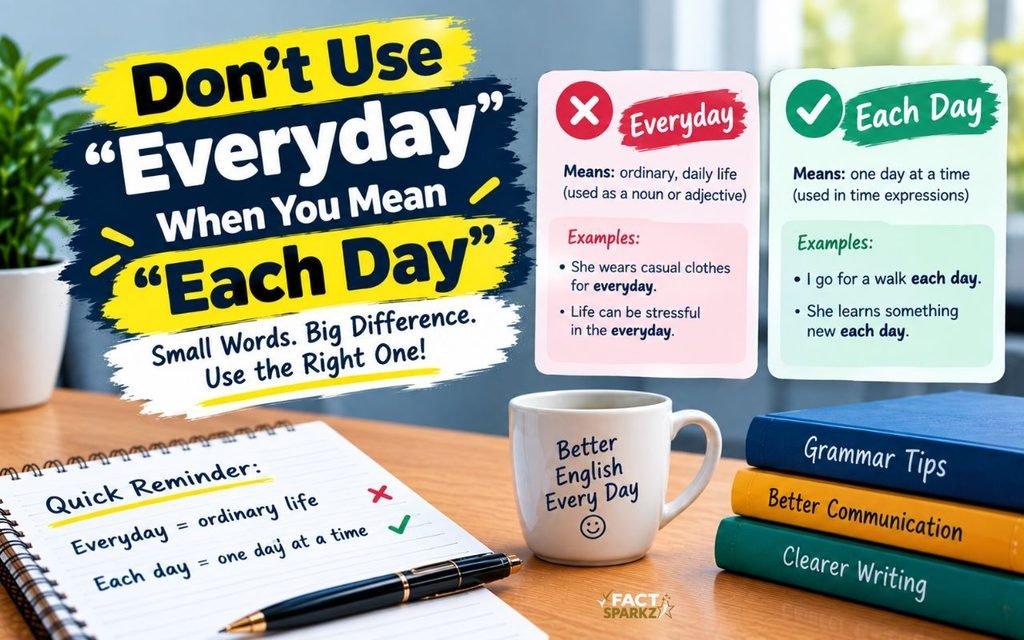
5. Don’t Use “Everyday” When You Mean “Each Day”
A common mistake is writing everyday as one word when the sentence needs the meaning “each day.”
Incorrect:
I go running everyday.
Correct:
I go running every day.
Why?
Because “every day” tells us how frequently the action happens.
Another example:
Incorrect:
She studies everyday.
Correct:
She studies every day.
The sentence doesn’t describe what kind of studying it is. It tells us when the studying happens.
6. Don’t Automatically Use “Every Day” Before a Noun
The opposite mistake also occurs.
If you’re describing a noun with the meaning ordinary, usual, or routine, use everyday.
Incorrect:
These are my every day shoes.
Correct:
These are my everyday shoes.
Why?
Because “everyday” is functioning as an adjective describing shoes.
Another example:
Incorrect:
We discussed several every day problems.
Correct:
We discussed several everyday problems.
Here, the intended meaning is ordinary or common problems.
7. Use Context to Choose the Correct Form
Sometimes the easiest solution is to focus on the meaning rather than memorizing grammar terminology.
Ask yourself:
Am I describing something as ordinary or routine?
If yes, use everyday.
This is an everyday situation.
Am I saying something happens each day?
If yes, use every day.
This happens every day.
That simple distinction handles most everyday vs every day questions.
Everyday vs Every Day Examples
Here are several examples that show the difference clearly.
Example 1
Everyday:
These are my everyday shoes.
Meaning: These shoes are suitable for regular use.
Every day:
I wear these shoes every day.
Meaning: I wear them each day.
Example 2
Everyday:
Traffic is an everyday problem in large cities.
Meaning: Traffic is a common or routine problem.
Every day:
Thousands of people deal with traffic every day.
Meaning: They deal with it each day.
Example 3
Everyday:
She prefers everyday language.
Meaning: She prefers ordinary or commonly used language.
Every day:
She practices speaking English every day.
Meaning: She practices each day.
Example 4
Everyday:
Exercise can become part of your everyday routine.
Meaning: Exercise can become part of your normal routine.
Every day:
He exercises every day.
Meaning: He exercises each day.
Example 5
Everyday:
Smartphones are an everyday part of modern communication.
Meaning: Smartphones are a normal part of communication.
Every day:
Millions of people use smartphones every day.
Meaning: They use them each day.
A Simple “Each Day” Test
When you’re unsure between everyday vs every day, replace the phrase with each day.
If “each day” works:
Use every day.
I check my messages every day.
→ I check my messages each day.
Correct.
If “each day” doesn’t work:
You may need everyday.
These are my everyday shoes.
→ These are my each day shoes.
That sounds incorrect.
Therefore, everyday shoes is the correct form.
This test is especially helpful when you’re writing quickly.
Everyday vs Every Day in Questions
The same rule applies when you’re asking questions.
For example:
Do you exercise every day?
Here, every day means each day.
But:
What do you wear for everyday activities?
Here, everyday describes activities that are ordinary or routine.
Another example:
How often do you check your email every day?
This sentence is awkward because “how often” already asks about frequency, but the key point remains that every day refers to frequency.
A more natural version is:
Do you check your email every day?
Can “Everyday” Be Used as a Noun?
In standard modern English, everyday is primarily used as an adjective.
You may occasionally see informal uses where people treat it differently, but in ordinary writing, don’t use everyday as a replacement for every day.
For example, avoid:
I do this everyday.
Write:
I do this every day.
This is one of the most common corrections in everyday English.
Is “Everyday” One Word or Two?
Both forms are correct, but they have different functions.
Everyday = one word and usually an adjective.
Every day = two words and means each day.
A quick comparison:
Everyday clothes = ordinary or regular clothes.
I wear these clothes every day = I wear them each day.
The spelling difference is small, but the grammatical difference is important.
Common Mistakes With Everyday and Every Day
Mistake 1: “I work everyday.”
Incorrect when the intended meaning is “I work each day.”
Correct:
I work every day.
Mistake 2: “These are my every day shoes.”
Incorrect when describing shoes as ordinary or regularly used.
Correct:
These are my everyday shoes.
Mistake 3: “She calls me everyday.”
Correct:
She calls me every day.
Mistake 4: “This is an every day activity.”
Correct:
This is an everyday activity.
Mistake 5: “We face these challenges everydays.”
Incorrect.
The correct expression is:
We face these challenges every day.
There is no plural “everydays” in this usage.
Everyday vs Every Day: Quick Comparison
| Feature | Everyday | Every day |
|---|---|---|
| Number of words | One | Two |
| Main function | Adjective | Adverbial phrase |
| Basic meaning | Ordinary, usual, routine | Each day |
| Usually followed by a noun? | Yes | No |
| Can mean “each day”? | No | Yes |
| Example | everyday life | I exercise every day |
The easiest distinction is:
Everyday = what kind?
Every day = when/how often?
For example:
What kind of shoes? Everyday shoes.
How often do you wear them? Every day.
Easy Memory Trick
Here’s a simple trick you can remember:
If “each day” works, use two words: every day.
If you’re describing something as ordinary or routine, use one word: everyday.
You can also remember:
Everyday = adjective
Every day = each day
This works for most normal writing situations.
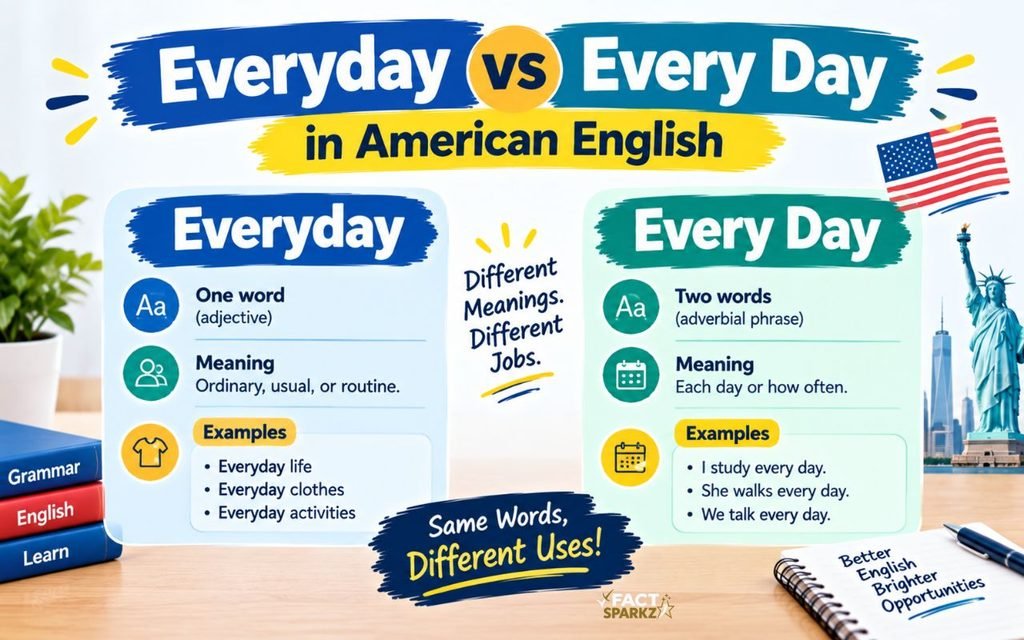
Everyday vs Every Day in American English
The distinction between everyday and every day is the same in American English.
Since both forms are common in everyday communication, native speakers generally understand the intended meaning from context. However, using the correct form is important in professional, academic, website, and formal writing.
For example:
We provide everyday solutions for common problems.
Here, everyday describes solutions.
But:
We publish new articles every day.
Here, every day describes how often the articles are published.
Correct usage makes the meaning immediately clear.
How to Remember the Difference Quickly
If you only remember one rule from this guide, remember this:
“Everyday” describes a noun.
everyday clothes
everyday life
everyday language
everyday activities
everyday problems
“Every day” describes frequency.
work every day
study every day
exercise every day
call every day
practice every day
Think of it as:
Everyday = ordinary
Every day = each day
Once this becomes familiar, the difference is much easier to spot.
Frequently Asked Questions
Is everyday one word or two?
Everyday is one word when it functions as an adjective meaning ordinary, usual, or routine. Every day is two words when it means each day.
Is it “I use it everyday” or “I use it every day”?
The correct sentence is:
I use it every day.
Here, every day means each day and describes how often the action happens.
Is “everyday life” correct?
Yes. Everyday life is correct because everyday describes the noun “life.” It means normal or ordinary life.
Is “everyday” an adjective?
Yes. Everyday is normally an adjective. It describes something ordinary, usual, routine, or commonly encountered.
Can I replace “every day” with “each day”?
Usually, yes. Both phrases generally express the idea of something happening on each individual day.
For example:
I study every day.
and
I study each day.
have essentially the same meaning.
Can I replace “everyday” with “each day”?
No, not when everyday is being used as an adjective.
For example:
everyday clothes
cannot naturally become:
each day clothes
The first phrase describes ordinary or routine clothes.
Is “everyday” the same as “daily”?
Not always.
Daily can mean happening each day, while everyday usually means ordinary, usual, or routine.
For example:
I take my daily medication.
means medication taken each day.
But:
This is an everyday activity.
means it is a normal or routine activity.
Which is correct: “everyday activities” or “every day activities”?
Usually, everyday activities is correct when you mean normal or routine activities.
Example:
Cooking and cleaning are everyday activities.
If you mean activities that happen each day, you could restructure the sentence:
These activities happen every day.
Which is correct: “everyday use” or “every day use”?
When describing something as suitable for normal or regular use, everyday use is correct.
Example:
This backpack is designed for everyday use.
Is “everyday” commonly confused with “every day”?
Yes. They sound almost identical when spoken, which is why the distinction can be difficult for learners and native speakers alike. The key difference is grammatical function and meaning.
Final Takeaway
The difference between everyday vs every day is simple once you focus on what the phrase means.
Use everyday as an adjective when you mean ordinary, usual, or routine:
These are my everyday shoes.
Use every day when you mean each day:
I wear these shoes every day.
When you’re unsure, try replacing the phrase with “each day.” If the sentence still makes sense, every day is probably the correct choice.
If you’re describing a noun as ordinary or routine, use everyday.
So remember:
Everyday = ordinary or routine.
Every day = each day.
That small spelling difference can make your writing much clearer, especially in emails, schoolwork, professional content, and everyday English.

Professional content writer and digital researcher specializing in internet culture, viral trends, memes, and online terminology.
1 thought on “Everyday vs Every Day: 7 Clear Rules & Helpful Examples”